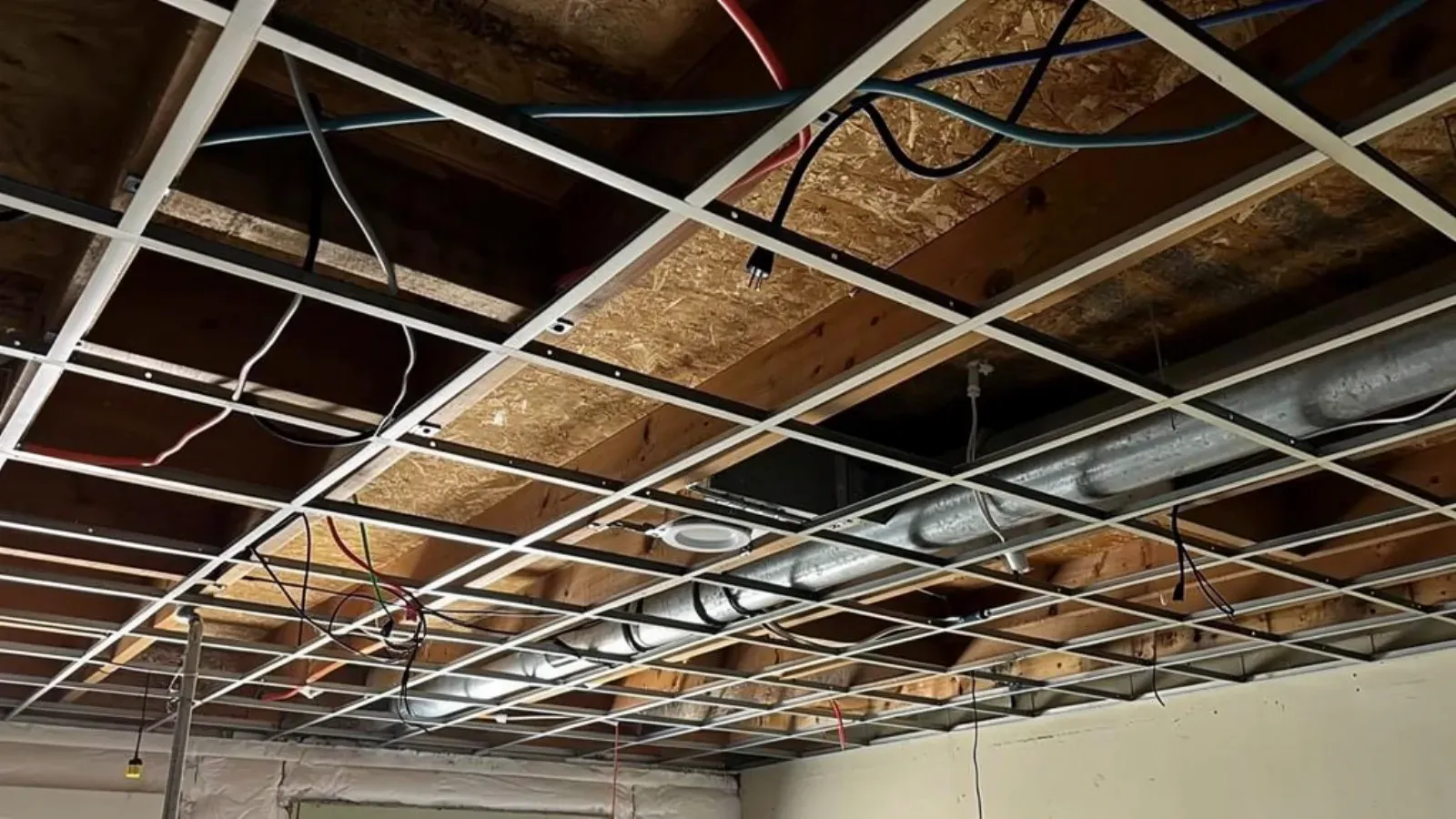
Signs you need this
- • Sagging, stained, or water-damaged acoustical ceiling tile in an office suite, common area, or classroom that looks bad to tenants, employees, or students long before anything actually fails
- • A grid that's visibly out of level or racked after a partial demolition or a prior tenant's build-out left the suspension system unsupported in places
- • A tenant improvement plan that calls for a new ceiling height, a different tile module, or added access panels for mechanical equipment above the old grid
Replacing a grid at an occupied office park without touching the tenants’ day
Norwalk Drywall & Plaster installs and repairs suspended ceiling grids in the corporate office space around Norwalk, and the recurring scope isn’t the ground-up new build, it’s the occupied floor that needs a section fixed without anyone downstairs noticing. Office parks like Merritt 7 run tenants like FactSet and Datto on schedules that don’t leave room for a contractor tearing out ceiling tile during the workday, so most of this work happens after hours or over a weekend: we walk the space during the day to confirm the grid module and where the sag or staining actually originates, then come back once the floor is empty to do the cutting and hanging. A grid that’s sagging in a corporate office is rarely just a bad tile; it’s usually a support wire that was never properly tied off during a prior build-out, or a tile that absorbed water weight from a slow leak nobody noticed until the ceiling started to bow. We check the wire and runner condition around the damaged section before we ever set new tile, because replacing the tile without fixing the support just buys the tenant another six months before it sags again.
New tenant improvement work is its own scope entirely. When a floor gets demolished back to the deck for a new tenant, we hang an entirely new grid from scratch: main runners and cross tees set to the module the architect specified, leveled to the room rather than to the old ceiling line, with seismic bracing added or verified against current code rather than assumed from whatever was there before. That’s also where the coordination gets real, because the grid has to accommodate every light fixture, HVAC diffuser, sprinkler head, and access panel the mechanical and electrical trades need cut in, and getting that sequencing wrong means either reopening a finished grid or leaving a trade waiting on us.
Working around a school calendar instead of a business day
Institutional ceiling work runs on a different clock than an office floor. At a campus like CT State Community College Norwalk, classroom and corridor ceiling tile has to be scheduled around breaks and the academic calendar rather than an evening or a weekend, because a torn-out grid in a hallway during the term isn’t an inconvenience, it’s a life-safety and access problem for a building full of students. We plan that work to land in the windows when a building is actually empty, and we treat access panels and fixture cutouts the same way we would on a corporate floor: coordinated with whatever mechanical or electrical trade needs the opening, so nobody is cutting into a grid we just finished leveling.
The most common shortcut we see from a generic crew is skipping the bracing check on a repair, because it’s invisible once the tile goes back in and nobody checks it at handoff. We verify and add seismic bracing as part of the same scope rather than assuming an older grid already meets current code, because a section that looks fine with new tile in it is still an unbraced hazard if the building shakes. That’s the difference between a ceiling that looks finished at the punch walk and one that’s actually built to hold.
Materials & standards
Products & materials we use
- USG
- National Gypsum Gold Bond
- CertainTeed
- Georgia-Pacific
Standards & codes we work to
- 2022 Connecticut State Building Code (2021 IBC/IRC-based)
- ADA
- GA-216
What the terms mean
- Suspended acoustical ceiling
- grid
- main runner
- cross tee
- ACT tile
- seismic bracing
- access panel
Options & variants
| Option | When it applies | Cost |
|---|---|---|
| Full new suspended grid | Tenant improvement after demolition, or a space with no existing ceiling system | Complete main runner and cross tee layout to the specified module, hung to level |
| Partial grid or tile repair | Isolated water damage, sagging, or a section damaged during other trade work | Matched tile and grid components tied into the existing system without disturbing the rest of the ceiling |
| Access-panel and cutout work | Mechanical, electrical, or fire protection scope requiring new penetrations through an existing grid | Coordinated cutouts and support added around fixtures without compromising the grid's level or seismic bracing |
What to expect
- 1
Confirm grid module and scope
We walk the space or review the tenant-improvement drawings to confirm grid module, ceiling height, and how many fixtures and penetrations the grid needs to carry.
- 2
Schedule around occupied hours
We schedule the work around the building's occupied hours if it's happening in a working office or institutional space.
- 3
Hang and level the grid
We hang and level the main runners and cross tees to the specified module, adding or verifying seismic bracing where required.
- 4
Coordinate cutouts with other trades
We coordinate cutouts for light fixtures, diffusers, sprinkler heads, and access panels with the other trades before setting tile.
- 5
Install tile and punch out
We install the acoustical tile, walk the grid for level and fit, and punch out before handing the space back.
When this isn’t the right call
- If the ceiling issue is actually a fire-rated shaft wall or corridor assembly that ties into the grid, that scope is handled under our fire-rated drywall assembly service, not as ceiling tile work.
- If the space needs new interior partitions framed before a ceiling grid can go in, that's our metal stud framing and commercial drywall service first.
- If the staining on the tile is a symptom of an active roof or plumbing leak rather than a ceiling installation issue, that leak needs to be fixed before any ceiling work will hold.
Frequently asked questions
Can you replace ceiling tile in our office without shutting the floor down during business hours? +
In most cases yes, we schedule tile and grid work after hours or on weekends at occupied office space, including tenant floors at office parks like Merritt 7, so the space is ready when employees are back.
Do you match existing tile, or does a repair mean replacing the whole ceiling? +
Where the tile is still in production we match it and tie the repair into the existing grid. Where it's been discontinued, we'll tell you that up front and price options rather than assuming a full replacement is needed.
What causes a suspended grid to sag or go out of level? +
Usually it's a support wire that was never properly tied off, water weight from a tile that absorbed a leak, or a prior trade that used the grid to support something it wasn't rated to carry.
Do you add seismic bracing, or is that a separate scope? +
We verify and add seismic bracing as part of the grid installation where code or the drawings require it, rather than treating it as a separate trade to schedule later.
Can you work around classroom or campus schedules for institutional buildings? +
Yes, we sequence ceiling work at institutional facilities such as CT State Community College Norwalk around breaks and off-hours so classrooms and corridors are ready for the term.
Do you cut in access panels for mechanical equipment above the ceiling? +
Yes, we coordinate with the mechanical and electrical trades to cut in access panels and fixture openings without compromising the grid's level or its bracing.