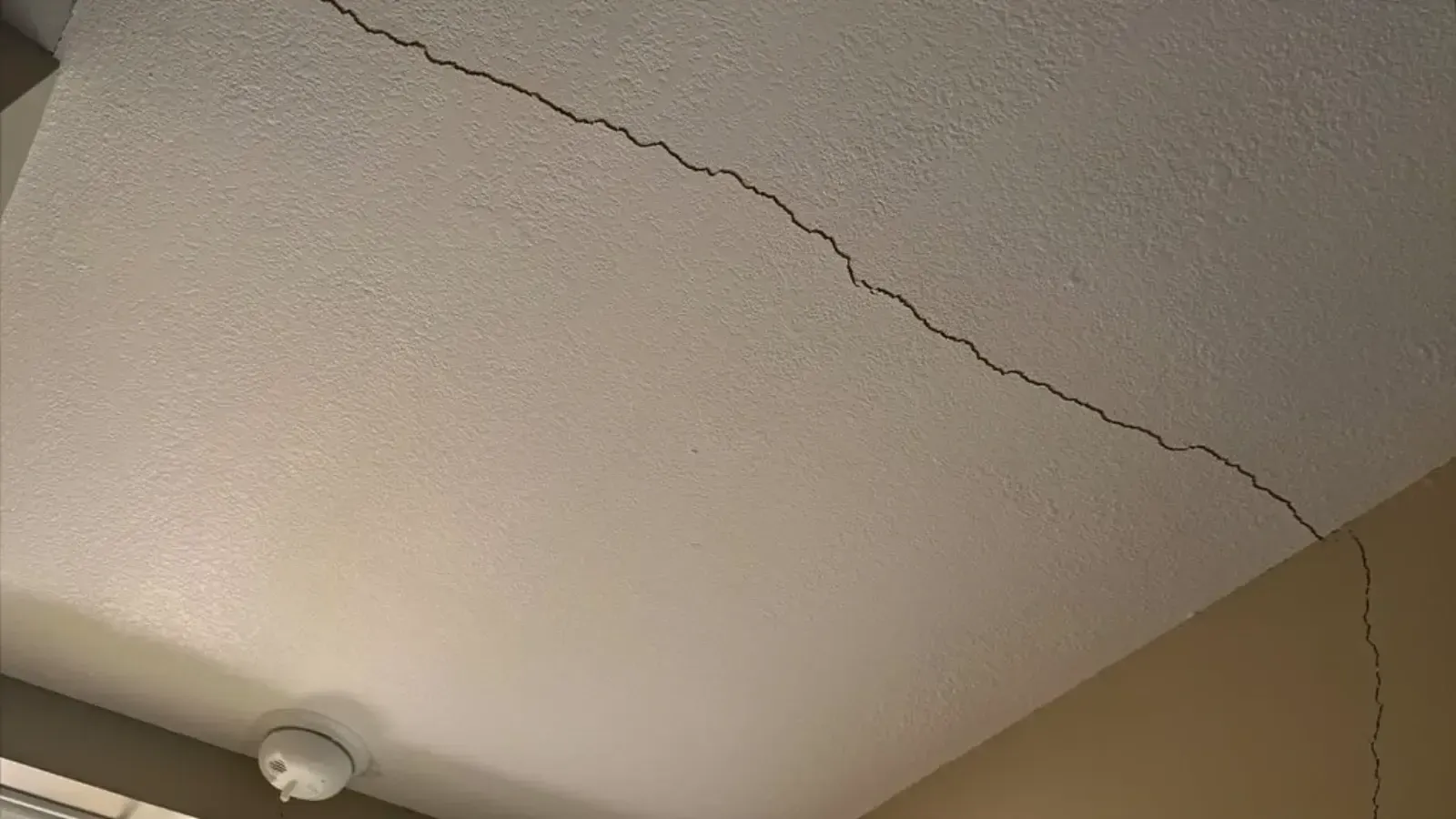
Signs you need this
- • A ceiling that sags or bellies between the joists, sometimes visible as a wave under raking light
- • A ring or brownish stain on the ceiling plane, whether old or still active
- • Cracks running along the ceiling-to-wall seam, or a web of hairline cracks across an older plaster ceiling
- • A pattern of small round bumps along the joist lines from popped nail or screw heads
- • Flaking plaster or texture, or a soft, spongy feel when the ceiling is pressed lightly
Why plaster ceilings sag long before they ever crack
Norwalk Drywall & Plaster gets the same call from Rowayton, Wilson Point, and Bell Island: a ceiling that’s visibly bowing between the joists but hasn’t actually cracked open yet. In an original lath-and-plaster ceiling, the plaster was never glued to anything. It was pushed through gaps in thin wood lath strips and formed small mushroom-shaped “keys” on the back side as it set, and those keys are the only thing holding decades of ceiling weight up against gravity. Age, humidity swings off Norwalk Harbor, and years of footsteps from the floor above break the keys off one by one, and once enough of them fail, the whole plaster field starts to sag as a sheet even while the painted surface still looks intact. We test for this with a flat hand and a light push rather than guessing from the floor: a plaster ceiling that flexes and springs back is usually salvageable by re-securing it to the lath from below with plaster washers and adhesive, then skim-coating over the repair so the fix disappears into the surrounding finish. A ceiling that feels soft and doesn’t spring back has lost its keys over too wide an area to save section by section, and at that point the honest answer is a full re-hang rather than a patch that won’t hold.
When a stained ceiling is a repair, not a remediation
Norwalk Drywall & Plaster runs a moisture meter on every stained ceiling before quoting the fix, because the same brown ring can mean two very different jobs. If the source is long gone, an old roof leak that’s since been re-flashed, a bathroom fan that used to vent into the attic before someone corrected it, and the board reads dry, we cut back only the discolored area, treat it with a stain-blocking primer, tape and feather a patch, and match the texture so the repair disappears. If the meter reads wet, or there’s an active source still feeding the stain, that’s a different scope entirely, and we point the homeowner to our water damage work instead, because drying the cavity and confirming the framing before closing it back up is a different process than a cosmetic patch. We draw the same line with mold: a dry stain with no odor and no dark speckling gets patched here; anything with visible growth or a musty smell gets handled as remediation, not folded into a ceiling patch. The distinction matters because closing a wet or contaminated ceiling back up with a quick skim coat is exactly how a homeowner ends up paying for the same ceiling twice.
Nail pops and truss uplift in West Norwalk’s ranches and colonials
Norwalk Drywall & Plaster fields a specific pattern of calls from West Norwalk, Cranbury, and Spring Hill’s postwar drywall-ceiling homes every fall and spring: a hairline crack running the full length of where the ceiling meets an interior partition wall, opening slightly in winter and nearly closing by summer. That’s truss uplift, the roof trusses bowing upward a fraction of an inch as the top chord dries out faster than the bottom chord in heating season, pulling the ceiling drywall away from the wall drywall at that seam. It looks alarming because it runs the whole length of the room, but it isn’t a settling crack; it’s a seasonal, repeating movement built into how trusses behave. We repair it with a control joint or a flexible taping detail at that seam instead of a rigid patch, so the crack has somewhere to open and close without telegraphing back through the paint every winter. That’s a different diagnosis, and a different fix, than the corner-to-corner or stair-step cracks we treat separately as settling cracks; a ceiling-to-wall seam that comes and goes with the seasons and a diagonal crack that keeps growing are two different failures, and matching the fix to the actual mechanism is what keeps the repair from cracking again next year. We also re-set the popped nail and screw heads that show up alongside it, since fastener pops along the joist lines are the second half of the same framing-movement story.
Materials & standards
Products & materials we use
- USG Sheetrock
- National Gypsum Gold Bond
- FibaTape
- corner bead
Standards & codes we work to
- GA-214 finish levels (Level 0-5)
- GA-216
- 2022 Connecticut State Building Code
What the terms mean
- lath and plaster
- plaster keys
- nail pop / screw pop
- skim coat
- knockdown texture
- joint compound
- mud and tape
Options & variants
| Option | When it applies | Cost |
|---|---|---|
| Fastener re-set & patch | Isolated nail pops or a small sagging area near one joist | Smallest job, priced per spot |
| Skim coat re-level | Widespread hairline cracking or a slightly wavy plane that's still structurally sound | Mid-size, priced by sqft like other Level 5 work |
| Full ceiling re-hang | Lath has lost its keys over a wide area, or drywall has failed at multiple joists | Largest scope, closer to a tear-out and re-board |
What affects cost
- • Ceiling material: lath-and-plaster versus drywall changes the method and the labor time
- • Texture match: smooth Level 5, knockdown, or orange-peel each take different skill and drying time to blend invisibly
- • Access: light fixtures, ceiling fans, and furniture that need to come down and go back up
- • Extent: one soffit-sized patch versus a whole room's ceiling
- • Paint: feathering into existing paint versus a full repaint for an even sheen
What to expect
- 1
Inspect the ceiling
We inspect the ceiling from underneath and, where attic access allows, from above to check the framing and any moisture history.
- 2
Press-test the area
We press-test the suspect area to find how far the sag or crack actually extends past what's visible.
- 3
Re-secure or cut back
We re-secure loose lath or drywall to the framing, or cut back to sound material where it's failed.
- 4
Tape and match texture
We tape, coat, and feather the repair to match the existing texture.
- 5
Sand, prime, and paint
We sand, prime, and either spot-paint or repaint the full ceiling, depending on what the customer chose.
When this isn’t the right call
- If the ceiling stain is from an active leak or recent flooding, water damage drywall repair is the better fit.
- If the ceiling shows dark spotting, a musty smell, or known mold growth, mold drywall replacement is the better fit.
- If the goal is converting an original plaster ceiling to drywall entirely, not repairing it, plaster repair and conversion is the better fit.
Frequently asked questions
My ceiling has a brown stain but it's dry to the touch. Do I still need repair? +
Usually, yes. A dry stain almost always means an old leak that's since been fixed, but the gypsum or plaster underneath already lost strength where it got wet, so it can sag or crack later even though it looks stable today.
Is a sagging ceiling dangerous? +
Most sagging we see in Norwalk homes is a finish problem, loose plaster keys or fasteners pulling through drywall, not a structural failure of the joists. We'll tell you plainly if something looks structural so you can bring in a structural engineer before we touch it.
Can you match my ceiling's texture so the repair doesn't show? +
Yes. We match smooth Level 5, knockdown, and orange-peel textures, and we test the match on a scrap or an inconspicuous corner before committing to the whole ceiling.
Why does my ceiling have a pattern of small round bumps? +
That's nail or screw pops, where the fastener holding the board to the joist works loose over time, often from framing shrinkage or seasonal movement. We re-set or replace the fastener and skim over it so it doesn't return.
My house is on Rowayton's older side with an original plaster ceiling. Can you repair it without tearing it all out? +
In most cases, yes. If the plaster keys, the small wedges of material gripping the lath, have only failed in one section, we can consolidate or re-secure that area and skim-coat to blend it, rather than removing the whole ceiling.
How long does a typical ceiling repair take? +
A single patched area is usually a one-day job start to finish. A full skim-coat re-level or a multi-fastener repair across a room runs two to four days once drying time between coats is counted.
Do I need to move out during the repair? +
No. We contain dust with plastic sheeting and a fan, and most ceiling repairs happen room by room while the house stays occupied.