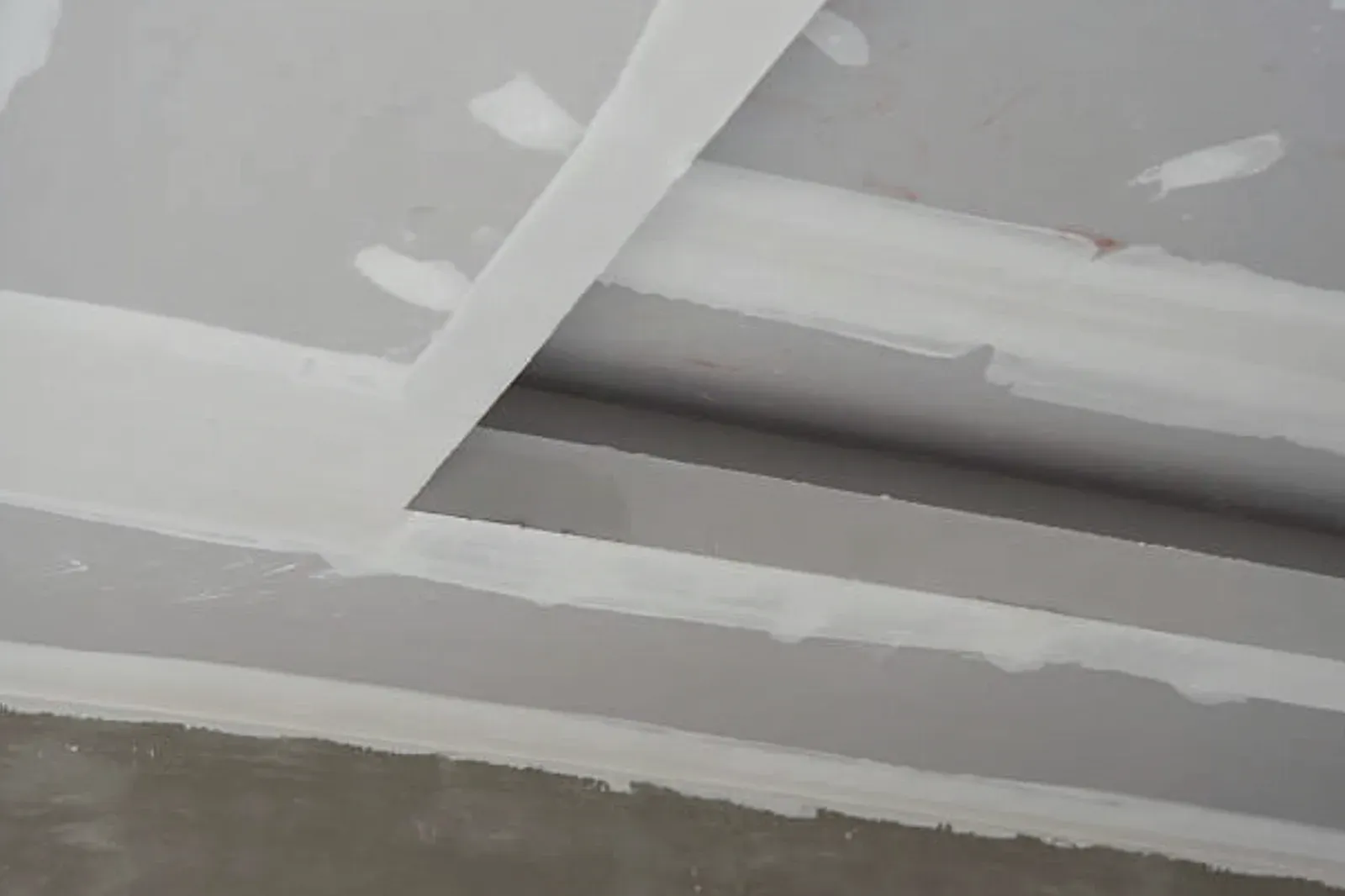
Signs you need this
- • Board is hung and screwed off, but every seam, corner, and fastener head is still visible, and the room isn't paintable yet
- • A general contractor or owner-builder has framers and hangers scheduled ahead of a painter, and the taping and finishing step is the piece that has to happen in between without slipping the timeline
- • A DIY or under-experienced attempt at taping has left visible ridges, bubbles, or cracking tape that needs to be redone before paint
What a GC is actually buying when they call us
Norwalk Drywall & Plaster gets most of its taping and finishing calls from general contractors and owner-builders managing a schedule, not homeowners shopping around, and that changes what the job actually is. A GC working a renovation near the Merritt 7 corridor or in the Wall Street / West Avenue redevelopment area doesn’t just need seams taped, they need a finisher who shows up on the day the framer and hanger finish and doesn’t hold up the painter behind them. We’ve watched a tight schedule fall apart because a finishing sub treated the job like a standalone project instead of the middle link in a chain, coating one slow layer at a time with no urgency about the painter waiting on the other end. That’s the difference we try to be reliable about: confirming the finish level before we start, so there’s no mid-job debate about whether a room needs Level 3 or Level 4, and sequencing coats so drying time doesn’t silently eat days out of a schedule nobody built slack into.
The finish level conversation matters more than it sounds like it should. Level 4, taped joints and fastener heads coated enough to disappear under flat or low-sheen paint, is the right, cost-appropriate spec for the overwhelming majority of rooms in a house or a unit. Level 3, fewer finish coats, is correct, not cheaper-and-worse, for any wall getting heavy texture or wallcovering, since those coverings hide exactly what the extra Level 4 coats would have smoothed. Specifying Level 4 everywhere out of habit wastes labor on walls that a texture or a covering will hide anyway, and a GC managing a tight budget on a multi-unit job feels that waste multiplied across every unit. We ask what’s actually going over the wall before we quote the finish level, not after.
Why the corner is where a taping job usually fails first
If a Level 4 finish is going to fail, it fails at an inside corner or an outside corner bead before it fails in the open field of a wall, because corners take the most physical wear and the most visual scrutiny, right where two planes meet at an angle a homeowner’s eye naturally travels along. We set corner bead carefully and let the first coat over it fully set before building the next one, rather than rushing a second coat over compound that’s still soft, which is the single most common cause of a corner that cracks or shows a ridge months after the paint goes on and the GC has moved to the next job. On multi-unit new construction around Head of the Harbor, where we’re running the same finish level across a repeated unit layout, that corner discipline is what keeps unit six looking as clean as unit one instead of degrading as the crew speeds up over a production run. It’s a small habit with an outsized effect on whether a GC calls us back for the next building or moves on to someone else.
Materials & standards
Products & materials we use
- USG Sheetrock
- National Gypsum Gold Bond
- Georgia-Pacific ToughRock
- joint compound (setting-type and pre-mixed)
- FibaTape
- corner bead
Standards & codes we work to
- GA-214 finish levels (Level 0-5)
- ASTM C1396 / C840
- 2022 Connecticut State Building Code
What the terms mean
- taping
- mudding
- seam finishing
- feathering
- corner bead
- finish levels
- Level 3
- Level 4
- fastener head
- joint compound
Options & variants
| Option | When it applies | Cost |
|---|---|---|
| Level 3 finish | Areas getting heavy texture or wallcovering where a fully smooth finish isn't needed | Lower cost, fewer finish coats required |
| Level 4 finish | Standard finish for most rooms getting flat or low-sheen paint | Standard cost, the default spec for most residential work |
| Level 5 upgrade | Rooms with critical light, high-gloss paint, or designer specification | Higher cost, additional full-surface skim coats beyond Level 4 |
| Multi-unit production finishing | New multifamily construction with repeated unit layouts | Priced per unit or per sqft across the building, scheduled in sequence |
What affects cost
- • Square footage of board to be taped and finished, and how many corners, angles, and transitions the layout has
- • Finish level required: Level 3, Level 4, or a Level 5 upgrade for specific rooms
- • How tightly the job is scheduled against the GC's framing and painting dates, since a compressed schedule affects crew sizing
- • Ceiling height and any vaulted or complex ceiling geometry, which slows taping and finishing compared to flat 8-foot ceilings
- • Whether it's a single room, a whole house, or a multi-unit production job with repeated layouts
What to expect
- 1
Confirm the required finish level
We confirm the finish level required with the GC or homeowner before starting, since Level 3, 4, and 5 call for different numbers of coats and different scheduling.
- 2
Tape seams and corners
We tape every seam and inside corner, set corner bead on outside corners, and let the first coat set before coating over it.
- 3
Apply and sand successive coats
We apply and sand successive coats, feathering each one wider than the last so the finished joint disappears into the field of the board.
- 4
Final sand and raking-light check
We do a final sand and a raking-light check for any joints or fastener heads still showing before calling the finish level complete.
- 5
Hand off primer-ready on schedule
We hand the room off primer-ready on the GC's or homeowner's schedule, coordinated with the painter's start date.
When this isn’t the right call
- If the wall in question is already painted and lived-in and the goal is eliminating flash under raking light, that's a skim coat to Level 5 on an existing surface, not first-pass taping on new board.
- If the substrate is plaster on lath rather than hung drywall, that's plaster repair and conversion, a different material and process entirely.
- If the job is patching a hole, crack, or water-damaged section in an existing finished wall, that's drywall repair, not the initial taping and finishing pass on new board.
- If the finished texture needs to match an existing pattern elsewhere in the house rather than reading as a fresh, flat finish, texture matching after taping is the better fit for that specific step.
Frequently asked questions
What finish level does a typical Norwalk home need? +
Level 4 is the standard for most rooms getting flat or low-sheen paint. We'd only recommend Level 5 for specific rooms with critical light, like a wall facing large windows, or where a designer has specified a glossier paint.
Can you work around our GC's framing and painting schedule? +
Yes, this is scheduled work by nature, since we're the step between hanging and paint. We coordinate directly with the GC or homeowner-as-GC to hit the window between those two trades.
We already taped and finished the walls ourselves but the seams are still showing. Can you fix it? +
Yes, we can assess what's there and either add corrective coats over the existing tape or, if the tape itself has failed, pull it and start that section over.
Do you do multi-unit finishing for new construction, or just single homes? +
Both. We finish individual homes and additions as well as production runs across multiple units in new multifamily buildings, scheduled unit by unit or in sequence.
How long does taping and finishing take on an average room? +
It depends on finish level and room size, since each coat has to dry and be sanded before the next one goes on; a Level 4 finish on a standard room typically runs several days start to finish once drying time is factored in.
Is Level 3 finish actually lower quality than Level 4? +
No, it's the correct spec for its use case, typically a wall getting heavy texture or wallcovering where the extra smoothing coats of Level 4 would be wasted since the covering hides the surface anyway.