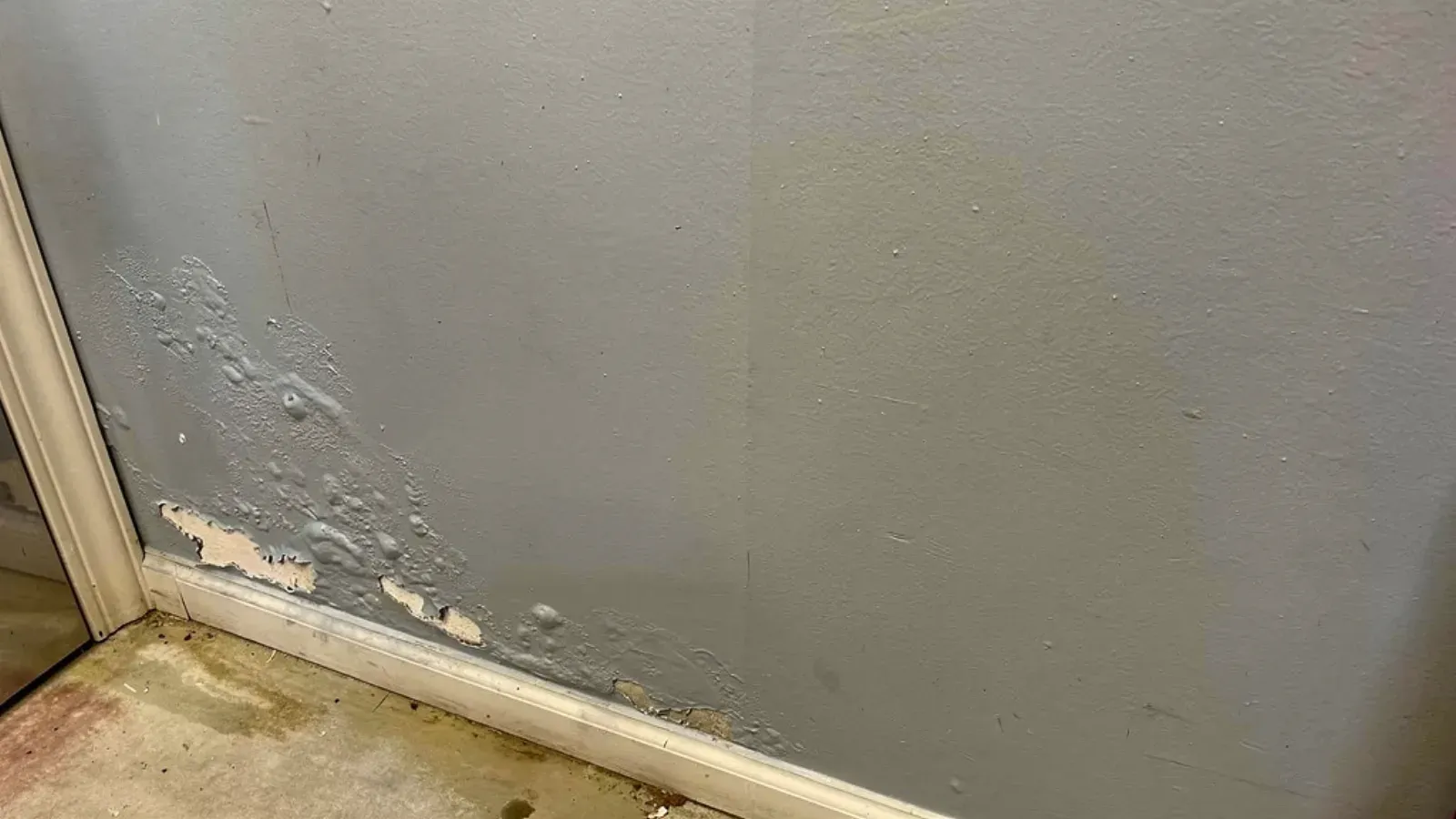
Signs you need this
- • A brown or amber ring on the ceiling, sometimes with a soft spot that flexes when pressed
- • A wall that bulges, feels spongy, or shows tape seams lifting after a pipe or ice dam let go
- • Paint blistering or wallpaper peeling in a band above the baseboard after harbor-edge flooding
- • A musty smell and cool, damp patches that never fully dry between rooms
Why coastal water damage in Norwalk is a cavity problem, not a stain problem
Norwalk Drywall & Plaster repairs water-damaged drywall in Norwalk’s harbor-edge and waterfront homes, where the damage a homeowner sees on the surface is almost always smaller than the damage inside the wall. A brown ring on a SoNo ceiling or a spongy band above the baseboard in an East Norwalk two-family means water has already been moving through the assembly for hours or days. The gypsum core swells, the paper facing lets go of the board, and the framing behind it holds moisture long after the surface looks dry. Lower Fairfield County gives this problem three regular sources: coastal flood-zone intrusion along Norwalk Harbor and the enclaves at Wilson Point, Bell Island, and Village Creek; winter ice dams that push meltwater down the wall cavity; and the burst supply lines that come with older plumbing in Rowayton and Harbor View colonials. Each one wets the cavity, and the cavity is what has to be addressed.
The common subpar fix is the one that feels like a solution: prime the stain, repaint, and move on. Within a season the ring bleeds back through, the tape seam lifts, or a musty smell shows up in the room, because the board never regained its bond and the framing was still wet when the paint went on. We cut a test opening before quoting so a homeowner can see the difference between a cosmetic touch-up and a real repair. We moisture-meter the board and the studs around the visible damage, then cut back only to sound, dry material, so we remove exactly what failed and no more. Wet insulation comes out, drying equipment goes on the open cavity, and nothing gets closed until the framing reads below 16%. That number is the whole job: new board hung over a cavity above 16% traps the water it was meant to fix, and the repair becomes the next mould call.
The insurance workflow and the finish match on a waterfront home
Norwalk Drywall & Plaster scopes water-damage repairs so they satisfy both the building and the insurer along Norwalk’s coast. Most flood and burst-pipe losses run through a claim, and adjusters want a licensed contractor’s documented scope, not a vague estimate. We photograph the source, log the moisture readings, record the tear-out and the drying, and rebuild to the 2022 Connecticut State Building Code with board finished to the right GA-214 level. On flood-exposed lower walls we specify moisture-resistant board above the established water line rather than dropping standard gypsum back into a spot that will wick again. Because so much of Norwalk’s core predates 1978, EPA RRP lead-safe practice governs the cutting and containment whenever we open older painted surfaces, which also keeps dust out of the rest of the home.
Finish is where a coastal repair is judged. Rowayton and the waterfront enclaves carry premium homes that expect a Level 5 skim on flat walls and ceilings, so a patch that reads as a patch under raking window light is a failed repair even if it is structurally sound. We texture-match knockdown and orange-peel surfaces where they exist and skim to a seamless plane where the home is finished smooth, then prime and walk the homeowner through the work with the documentation their claim needs. The payoff is a repair that disappears into the wall and does not come back the next wet season.
Materials & standards
Products & materials we use
- USG Sheetrock
- Gold Bond
- CertainTeed
- moisture-resistant board (USG Mold Tough, Gold Bond XP)
- FibaTape
- setting-type joint compound
Standards & codes we work to
- 2022 CT State Building Code (2021 IBC/IRC)
- ASTM C1396/C840
- GA-214 finish levels (Level 4/5)
- EPA RRP
What the terms mean
- moisture metering
- dry-out and verification
- cut-back to sound board
- cavity drying
- Level 4/5 finish
- knockdown texture matching
Options & variants
| Option | When it applies | Cost |
|---|---|---|
| Ceiling patch and refinish | Contained leak, framing dries within range, small area of lost board | Lowest scope; texture match drives most of the labor |
| Full wall-section replacement | Bulging or delaminated board along a run, wet insulation behind it | Adds cavity dry-out and insulation replacement |
| Flood-zone lower-wall rebuild | Harbor-edge intrusion wicking up from the sill plate | Cut above the water line, moisture-resistant board, longer dry time |
| Insurance-scoped full assembly | Adjuster requires documented tear-out, drying logs, and rebuild | Documentation and staging add coordination, not markup |
What affects cost
- • How far the water traveled — a single ceiling ring versus a soaked run of wall with wet insulation behind it
- • Moisture readings in the framing: a cavity that reads high needs dry-out days before any board goes back
- • Board type the assembly calls for (standard versus moisture-resistant on a flood-exposed lower wall)
- • Ceiling height and access, since taped ceiling repairs and Level 5 waterfront finishes take more staging and skim work
- • Texture and finish match to the existing surface, especially knockdown or a smooth Level 5 wall in a premium coastal home
- • Whether the work is scoped for an insurance claim, which adds documentation but not price
What to expect
- 1
Find and confirm the source
We come out, find and confirm the water source, and moisture-meter the surrounding board and framing so the scope matches the actual wet area.
- 2
Contain and protect
We contain the room with dust barriers and protect floors and belongings before any cutting.
- 3
Cut back and dry
We cut back to sound, dry board and pull wet insulation, then set drying equipment on the open cavity.
- 4
Verify the framing is dry
We verify the framing reads below 16% moisture before anything is closed up — no new board over a wet cavity.
- 5
Rebuild and finish
The crew hangs moisture-appropriate board, tapes, and coats to a Level 4 or Level 5 match.
- 6
Match, clean, and document
We texture-match, prime, clean the space, and walk you through the finished repair with any documentation your claim needs.
When this isn’t the right call
- If mould has already colonized the cavity or spread beyond the wet board, mold drywall replacement is the better fit.
- If the wall is original lath-and-plaster and the water only cracked or loosened the plaster keys, plaster repair and conversion is the better fit.
Frequently asked questions
Can you just paint over the water stain instead of cutting it out? +
Norwalk Drywall & Plaster only paints over a stain once the framing behind it reads dry, because gypsum that has lost its bond to the paper facing keeps failing under fresh paint and a wet cavity grows mould regardless of the finish on top.
How do you know the wall is actually dry before you close it up? +
Norwalk Drywall & Plaster takes moisture-meter readings in the framing and confirms they are below 16% before any new board goes on, so water is not sealed behind the new assembly.
My leak came from an ice dam this winter — is that the same repair? +
Yes. Norwalk Drywall & Plaster treats ice-dam water the same as a burst pipe: we open the assembly, dry the framing, and rebuild rather than patching the visible stain.
Will this work for an insurance claim? +
Norwalk Drywall & Plaster documents the source, the moisture readings, the tear-out, and the drying logs so the repair scope stands up when your adjuster reviews it.
Do you use special board near the harbor and waterfront? +
On flood-exposed lower walls, Norwalk Drywall & Plaster rebuilds with moisture-resistant board above the water line, since standard gypsum will wick and fail again in a coastal flood zone.