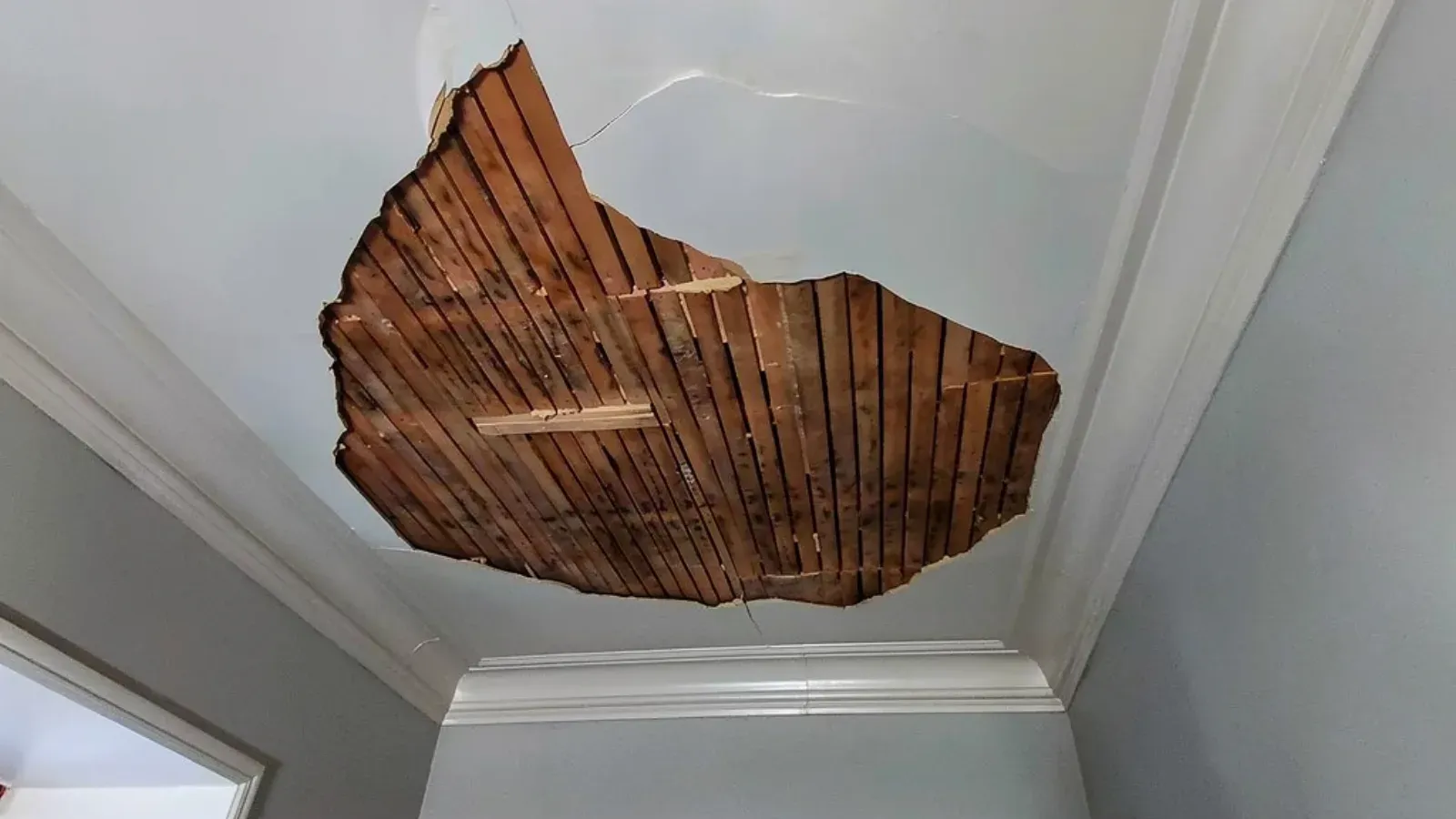
Signs you need this
- • Long map cracks and spider cracks running across walls and ceilings of an older Norwalk Center or Wall Street house
- • Plaster that sounds hollow when tapped, or a section that has bellied away from the wall
- • A sagging ceiling plane with visible waves, sometimes with keys crumbling into the attic above
- • Chunks of plaster failing at corners, around old door casings, or below a former leak
How lath-and-plaster fails in Norwalk’s pre-1940 houses, and why the fix depends on the keys
Norwalk Drywall & Plaster repairs cracked and detaching plaster throughout Norwalk Center, Wall Street, and the city’s older single-family and workers’-cottage stock, where the walls are original lath-and-plaster rather than drywall. Understanding why that plaster fails is what decides the right repair. A plasterer built these walls by troweling wet plaster over closely spaced wood lath, and the plaster that squeezed between the lath boards curled behind them into keys, which is what holds the whole surface in place. Decades of settlement, seasonal expansion, and vibration crack the brittle finish coat, and over time those keys snap. When they do, the plaster stops being locked to the lath and starts hanging on friction alone, which is why a Gold Coast antique colonial can show a wall that looks intact but sounds hollow and moves when pressed.
The mistake a general handyman makes is treating every crack as a filling job. Skimming joint compound over a wall whose keys have failed produces a smooth surface for one season, then the same cracks map back through and the detached section eventually bellies out, because nothing re-secured the plaster to the lath underneath. We assess the substrate first, sounding the wall for hollow areas and checking the lath before choosing a method. Where the keys still hold, we do a historic-sensitive skim, bonding and re-flattening the original plaster so the house keeps its real substrate and its slightly-imperfect period surface. Where the plaster has let go but is otherwise intact, we re-anchor it with plaster washers and screws, drawing it back tight to the lath before skimming. That distinction, key-intact versus key-failed, is the entire diagnosis, and it is what separates a repair that lasts from one that cracks again by next winter.
When conversion is the right call, and blending it into original plaster
Norwalk Drywall & Plaster converts plaster to drywall in Norwalk’s period homes only when the plaster is genuinely beyond saving, and it does the conversion so the room does not lose its character. In a Silvermine colonial or an older Wall Street two-family where a wall or ceiling has failed throughout, chasing endless washer repairs costs more than a clean conversion. We remove the failed plaster to the framing, protect and keep the original trim, casings, and any cornice, then hang drywall built up to match the original plaster wall thickness so the reveals at the windows and doors stay correct. Getting that thickness right is the detail most crews miss, and it is why a careless conversion leaves trim looking swallowed or proud.
The finish work is where a conversion succeeds or announces itself. We feather and blend the seam where new board meets surviving original plaster, then skim the plane to a Level 5 smoothness so raking light across the wall does not reveal the transition. On partial conversions, that blend is the whole job. Every one of these repairs runs under EPA RRP lead-safe containment, because a pre-1978 Norwalk house almost certainly carries lead paint on its plaster and trim, and cutting or sanding it without containment spreads dust through the home. Worked this way, the payoff is a wall that is flat, sound, and modern to live with while the house still reads as the period home it is.
Materials & standards
Products & materials we use
- USG Sheetrock
- Gold Bond
- CertainTeed
- setting-type joint compound
- FibaTape
- plaster washers
- bonding agent
Standards & codes we work to
- 2022 CT State Building Code (2021 IBC/IRC)
- ASTM C1396/C840
- GA-214 finish levels (Level 5)
- EPA RRP
What the terms mean
- lath-and-plaster
- plaster keys
- historic-sensitive skim over lath
- washer-and-screw stabilization
- plaster-to-drywall conversion
- blending the transition
- skim coat
Options & variants
| Option | When it applies | Cost |
|---|---|---|
| Historic-sensitive skim over lath | Plaster is cracked or crazed but the keys still hold | Lowest disruption; preserves the original substrate |
| Washer-and-screw re-anchoring | Plaster has detached from the lath but is otherwise intact | Stabilizes before skimming; avoids full tear-out |
| Partial conversion to board | One wall or ceiling has failed while the rest is sound | Blending the transition drives the finish labor |
| Full plaster-to-drywall conversion | Plaster is failing throughout a room and the owner wants modern walls | Tear-out plus trim protection and re-set |
What affects cost
- • Whether the plaster can be stabilized and skimmed or has to come off the lath entirely
- • The condition of the wood lath behind it, which decides whether the wall takes new plaster keys or a board conversion
- • How much original trim, casing, and cornice has to be protected, removed, and re-set to keep the room's character
- • Blending a converted wall into adjacent original plaster so the transition disappears, which is skilled finish time
- • Lead-safe containment, since nearly every pre-1978 Norwalk house carries lead paint on the plaster and trim
- • Ceiling versus wall work, as overhead plaster stabilization is slower and more staging-heavy
What to expect
- 1
Assess the plaster and lath
We assess the wall, sound out the plaster for hollow and detached areas, and check the condition of the lath behind it.
- 2
Contain and protect
We set lead-safe containment and protect trim, floors, and any plaster detail that stays.
- 3
Stabilize salvageable plaster
On salvageable walls we re-anchor loose plaster with washers and screws, then bond and skim it flat.
- 4
Convert where plaster has failed
Where plaster has failed, we remove it to the framing, keep the trim intact, and hang drywall to match the original wall thickness.
- 5
Blend the transition
We feather and blend the transition between new board and original plaster so no seam telegraphs.
- 6
Skim, match, and finish
The crew skims to a smooth finish, matches any texture, cleans up, and walks you through the repaired room.
When this isn’t the right call
- If the plaster failed because water is still getting into the wall, water damage drywall repair is the better fit.
- If the plaster is stained and musty from a chronically damp cavity with visible growth, mold drywall replacement is the better fit.
Frequently asked questions
Do I have to tear out all my plaster to fix these cracks? +
Norwalk Drywall & Plaster keeps original plaster wherever the keys still hold, re-anchoring and skimming it flat rather than converting a whole wall that only needs stabilizing.
What is the difference between skimming the plaster and converting it to drywall? +
Norwalk Drywall & Plaster skims to keep the historic plaster on the lath and re-flatten the surface, or converts by removing failed plaster to the framing and replacing it with board, recommending one over the other based on whether the lath and keys are sound.
Will a converted wall look different from the original plaster next to it? +
Norwalk Drywall & Plaster matches the new board to the original wall thickness and blends the transition so the converted section reads as part of the same wall, not a patch.
Why does plaster crack in these older Norwalk houses? +
Norwalk Drywall & Plaster sees plaster crack in these older houses because decades of settlement and seasonal movement stress the brittle finish and break the keys locking it to the lath, which is why re-anchoring matters as much as filling the crack.
Is lead paint a concern on my old plaster walls? +
Norwalk Drywall & Plaster assumes lead paint on almost every pre-1978 Norwalk home's plaster and trim, so we work these repairs under EPA RRP lead-safe containment to keep dust controlled.