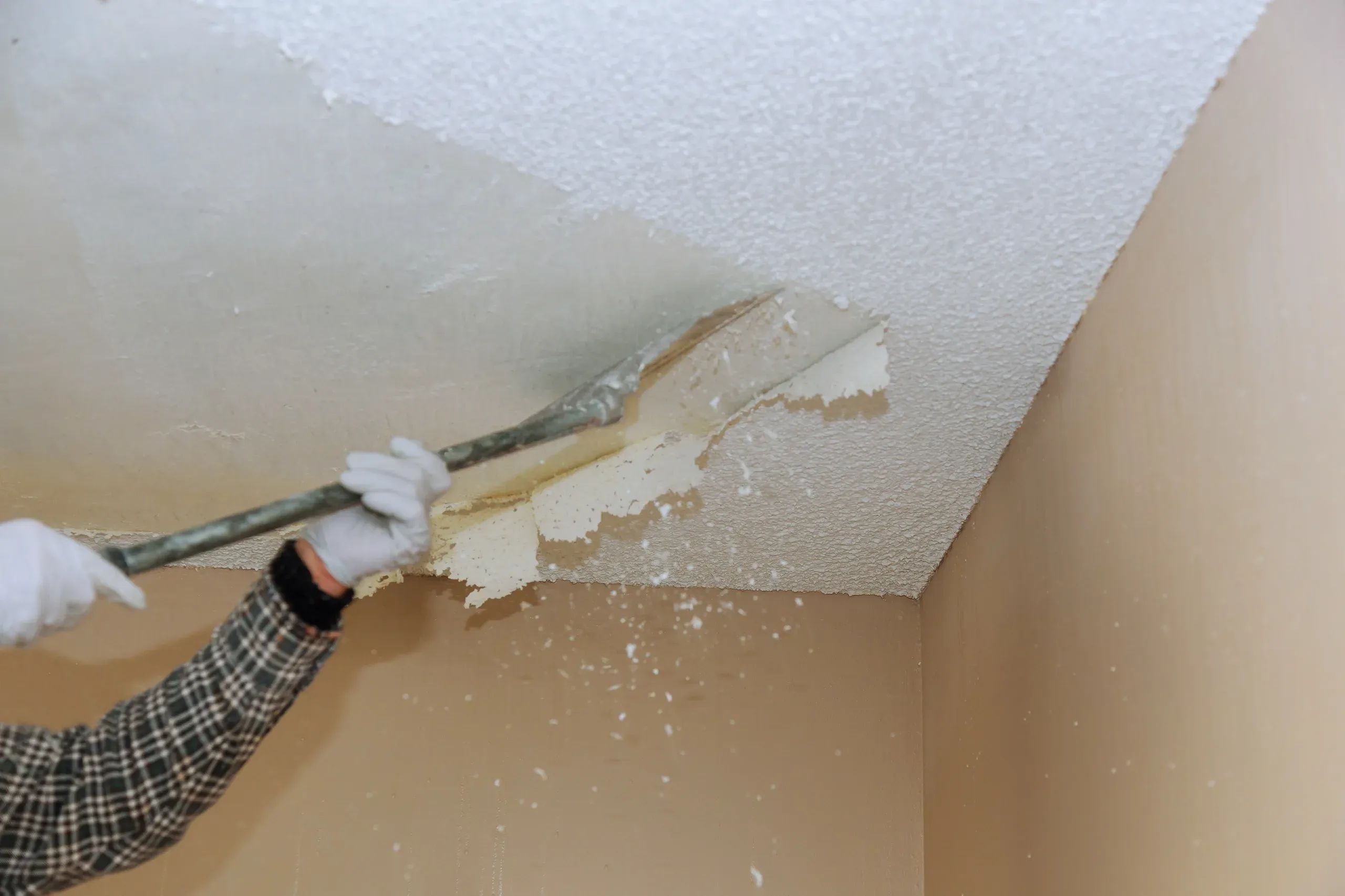
Signs you need this
- • A bumpy, spray-applied ceiling texture that dates the room and collects dust and cobwebs in a way a smooth ceiling never does
- • Yellowed or water-stained popcorn texture that can't be cleaned or painted back to looking fresh
- • A home inspector or appraiser flags the texture as original to the house and old enough that it may contain asbestos
Why the test comes before the scraper, every time
Norwalk Drywall & Plaster tests before we touch a popcorn ceiling, on every job, no exceptions, and we tell homeowners why the first time they call. The postwar and mid-century single-family stock around West Norwalk, Cranbury, Silvermine, Brookside, and Spring Hill was largely built during exactly the decades when sprayed acoustic ceiling texture was standard, and a meaningful share of that texture predates the 1978 federal ban on asbestos in these products. There’s no way to eyeball a ceiling and know which side of that line it falls on. A ceiling that looks fine, that’s been painted over once or twice, that the current owner has lived under for years without issue, can still test positive, and disturbing it without testing first is exactly how a routine renovation turns into an exposure problem. So we sample, send it to a lab, and wait for results before any scraper touches the ceiling. It costs a homeowner a few days of schedule. It’s not negotiable, and we don’t treat it as an upsell, it’s the difference between a controlled removal and a mistake that can’t be undone.
When a test comes back clear, the job is straightforward: wet the texture to keep dust down, scrape it off the board, and move to repair and finish. When a test comes back positive, we stop, full stop, and bring in a licensed abatement contractor to handle that specific removal under contained conditions, because that’s a different trade with its own containment and disposal requirements, not something a drywall crew should be doing even with good intentions. We come back once that’s done to repair and finish the ceiling. Homeowners sometimes push back on that handoff, wanting one crew to do the whole job start to finish, and we understand the instinct, but it’s the same reason we’d tell a homeowner to call an electrician rather than have us reroute a circuit: some parts of the job need a different license, and asbestos abatement is one of them.
What’s actually under the popcorn once it’s gone
The texture itself was often doing more work than homeowners realize, and not in a good way: it hides a lot of sins in the ceiling board underneath. Once we strip it off a Norwalk ceiling, it’s common to find fastener pops where the original screws or nails have worked loose over decades, seams that were never properly taped because the texture was going to cover them anyway, and the occasional sag from a ceiling that’s carried more insulation weight than it was built for. None of that shows up until the texture is gone, which is why we build skim and repair time into every removal quote rather than pricing it as a simple scrape-and-paint. Skipping that step is how a homeowner ends up with a smooth-looking ceiling on install day that shows every one of those old flaws again within a season, once the fresh paint stops hiding what the texture used to. We finish to a smooth Level 4 or 5 surface depending on the room’s lighting, since a ceiling under recessed cans needs the same raking-light attention a wall does, and we hand it off primer-ready so the homeowner’s next step is picking a paint color, not calling us back about a joint that’s already showing through.
Materials & standards
Products & materials we use
- USG Sheetrock
- National Gypsum Gold Bond
- joint compound (setting-type and pre-mixed)
Standards & codes we work to
- EPA RRP (pre-1978 lead-safe)
- GA-214 finish levels
- 2022 Connecticut State Building Code
What the terms mean
- popcorn ceiling
- acoustic texture
- asbestos testing
- abatement
- wet-strip removal
- skim coat
- ceiling resurfacing
Options & variants
| Option | When it applies | Cost |
|---|---|---|
| Test only, texture stays | Homeowner wants documentation before deciding whether to proceed | Lowest cost, no removal labor |
| Scrape and skim to smooth | Ceiling texture tests clear, homeowner wants a flat modern ceiling | Moderate cost, standard removal and finish |
| Asbestos-positive remediation | Testing confirms asbestos content | Highest cost, requires licensed abatement before any finish work |
| Board-over (new layer instead of scraping) | Existing ceiling is asbestos-positive or too damaged to strip safely | Avoids disturbing the old material, adds a new drywall layer instead |
What affects cost
- • Whether asbestos testing comes back clear or positive, since a positive result requires licensed abatement before we can touch the ceiling
- • Total ceiling square footage and number of rooms being done at once
- • How much patching the ceiling board needs once the texture comes off, since old fastener pops and seams are often hidden under the texture
- • Whether the homeowner wants a smooth Level 4/5 finish or a lighter replacement texture
- • Furniture, flooring, and fixture protection needs in an occupied home
What to expect
- 1
Test for asbestos first
We test a sample of the ceiling texture for asbestos before any scraping or sanding starts, and we wait for lab results before proceeding.
- 2
Protect the room and strip the texture
If the test is clear, we protect floors and furniture, then wet the texture and scrape it off the ceiling board.
- 3
Hand off to licensed abatement if positive
If the test comes back positive, we stop and bring in a licensed abatement contractor for that portion of the work; we don't remove known asbestos-containing material ourselves.
- 4
Repair and skim the ceiling board
Once the texture is off, we repair and skim the ceiling board underneath, since it's common to find fastener pops or seams the old texture was hiding.
- 5
Finish and hand off primer-ready
We finish the ceiling to a smooth Level 4/5 surface or a new, lighter texture, sand, and leave it primer-ready.
When this isn’t the right call
- If the homeowner just wants an existing patch or repair to blend into the surrounding texture rather than removing the texture entirely, texture matching is the better fit, not full removal.
- If the ceiling is plaster on lath rather than drywall with a sprayed-on texture, that's plaster repair and conversion territory, a different substrate and a different process.
- If testing confirms asbestos and the homeowner wants it gone rather than boarded over, a licensed abatement contractor has to handle the removal itself; we can coordinate the finish work that follows.
- If the ceiling just has a water stain or sag and the texture itself is fine, that's ordinary water damage or drywall repair, not a full texture removal.
Frequently asked questions
Do all popcorn ceilings in Norwalk need asbestos testing? +
Not every one contains asbestos, but any ceiling texture applied before the 1978 federal ban can't be assumed safe, so we test first on any house from that era before we scrape or sand anything.
What happens if the test comes back positive? +
We stop and bring in a licensed abatement contractor to remove the asbestos-containing material under contained conditions. We pick the project back up for the ceiling repair and finish work once that's cleared.
Can you just paint over the popcorn texture instead of removing it? +
Painting over it is possible but doesn't solve the dated look or the dust-collecting texture, and it doesn't answer the asbestos question either, since the material is still there under the paint.
How messy is popcorn removal in an occupied house? +
We protect floors, furniture, and fixtures before we start, but scraping and skimming a ceiling is genuinely dusty work; most homeowners either stay elsewhere for the day or seal off the room being worked on.
Will removing the popcorn leave a perfectly smooth ceiling automatically? +
No, we skim and finish the ceiling board after the texture comes off, since fastener pops, seams, and minor damage are usually hiding underneath and need their own repair before the final finish goes on.
Is there an alternative if we don't want to disturb an asbestos-positive ceiling at all? +
Boarding over the existing ceiling with a new layer of drywall is an option in some cases, since it avoids disturbing the old material while still giving a smooth, modern ceiling.